What 9 Out of 10 Online Entrepreneurs Forget (And Why It’s Costing Them Money)
What 9 Out of 10 Online Entrepreneurs Forget (And Why It’s Costing Them Money)
Have you ever wondered why some online businesses grow at lightning speed, while others get stuck in chaos? Almost always, the cause is an unclear or incomplete business model. That might sound boring, but trust me: if you ignore this, you’re not just missing out on revenue, you’re also losing the trust of potential customers.
Many entrepreneurs dive straight into branding or marketing without being clear on who they want to reach and why. The result: mixed messages, frustrated customers, and a strategy flying off in all directions. This is a waste, and completely unnecessary.

In this blog you’ll discover:
- Why a clear business model is your most powerful asset (and how you lose customers without one).
- How the Business Model Canvas helps you get every part of your business crystal clear on paper.
- How this makes it easier to build authority and get better returns from your marketing efforts.
- A real-world example (a driving school) that shows how to work the levers in practice.
- How the Canvas forms the springboard to the next step: Design Thinking.
- Focus and direction: You know where you’re going and can better judge which choices do or don’t fit your goals.
- Predictability and calm: A good strategy creates overview. You know what the next step is, which helps you avoid unnecessary stress.
- Faster growth: With a clear plan, you can make smarter use of market opportunities. Especially in a digital age where you need to move fast, clarity is gold.
Why everything starts to crumble without a strong foundation
Imagine visiting a company’s website and seeing no clear promise or added value. You’re left wondering who they’re actually for. There’s no common thread anywhere. Chances are you click away immediately. That’s the impact of an unclear business model.
- No customer trust: If you yourself aren’t clear on what you offer and to whom, that shows. People want to buy from businesses that truly understand their problems.
- Scattered marketing: Without a clear model, you might spend one week on Facebook ads, then suddenly switch to LinkedIn the next. You never really build momentum anywhere.
- Hard to scale: A solid business model shows you where the growth opportunities are. Without that overview, you keep “trying” new things instead of optimizing with purpose.
In short: if the foundation isn’t solid, every new layer you add, your branding, campaigns, product development, will be shaky.

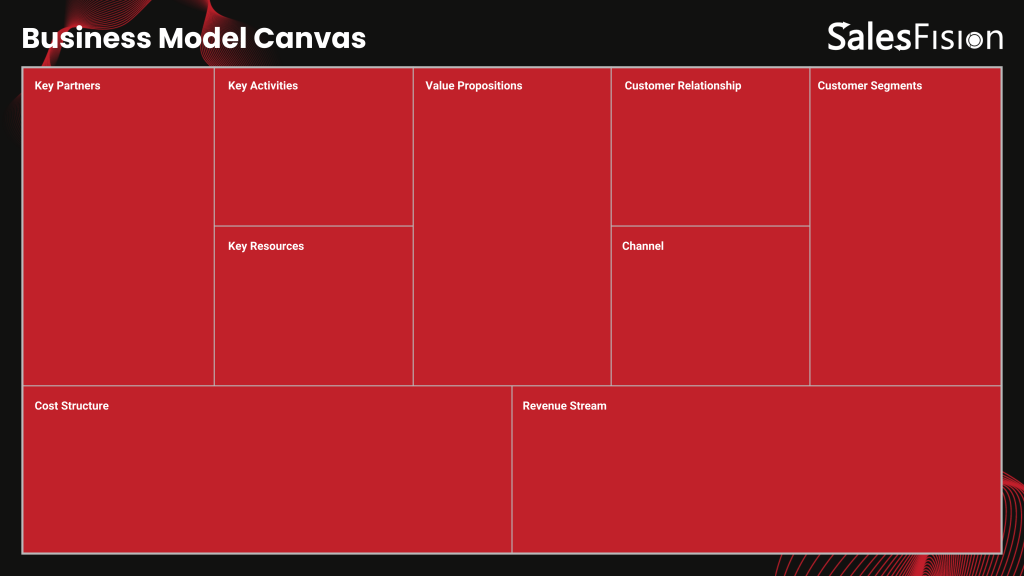
The Business Model Canvas: 9 building blocks for a rock-solid foundation
Fortunately, there’s a practical tool that shows you at a glance where you stand and where you need to go: the Business Model Canvas. This model consists of nine building blocks that together form the core of your business.
1. Customer Segments
Who are you actually doing this for? Are you targeting young parents, ambitious startups, or seniors? The more specific, the better.
2. Value Proposition
What is your unique promise? What problem do you solve or what desire do you fulfill for your customer?
3. Channels
Through which channels do you communicate and deliver your value? Think of your website, social media, newsletter, or partnerships.
4. Customer Relationships
How do you create interaction and connection with your customers? Will it be personal contact, an online community, automated emails, or a combination?
5. Revenue Streams
How does the money come in? Through product sales, subscriptions, licenses, advertising revenue, etc.?
6. Key Resources
What do you need to actually deliver your value? Think of specific software, staff, inventory, or intellectual property.
7. Key Activities
Which crucial tasks do you need to carry out every day to keep your business running and growing?
8. Key Partners
Who do you collaborate with to strengthen your business? These could be suppliers, affiliates, or other companies.
9. Cost Structure
What do you spend money on and how do you keep costs manageable?
Once you have these nine building blocks on paper, you get a crystal-clear picture of your business. You can immediately see whether certain parts contradict each other, or whether you might be overlooking something.

How this helps you build a rock-solid brand
By using the Business Model Canvas, you can shape your marketing and communication messages with real precision. Once you know exactly who your core audience is, you also know where to find them online and how to approach them.
- Authority and trust: A clear value proposition and customer-focused offering show that you know what you’re talking about. People connect when they feel understood.
- Consistent branding: All channels tell the same story. As a result, your audience recognizes your brand instantly, which increases the chance they’ll come back.
- Better returns: When you know what to focus on, you waste less budget and time on channels that don’t work. Instead, you invest in what truly makes an impact on your target audience.

Real-world example: How it works for a driving school
To show how the Canvas creates clarity in practice, let’s use a driving school as an example.
- Customer Segments: Young people aged 16.5 to 24, in and around a major city.
- Value Proposition: “Get your driving license fast, affordably, and with a high pass rate. Bonus: an online platform with self-study modules for the theory exam.”
- Channels: In-person driving lessons, social media (Instagram, TikTok) to reach young people, a website with lesson packages.
- Customer Relationships: Personal contact via WhatsApp and email, online tutorials for extra support.
- Revenue Streams: Per lesson package + subscription model for online theory lessons.
- Key Resources: Instructors, lesson cars, website, online learning environment.
- Key Activities: Giving driving lessons, delivering theory lessons through the platform, running social media ads.
- Key Partners: Car dealer for the lesson cars, software company for the online learning platform, schools where flyers can be placed.
- Cost Structure: Salary costs, car lease costs, social media advertising budget, hosting of the online learning environment.
Why this works:
- The driving school advertises specifically where young people spend their time, on TikTok and Instagram, which lowers recruitment costs and increases sign-ups.
- The online platform generates passive income and builds trust, because the driving school shares knowledge (authority).
- The message is clear: “Choose us, because we help you pass fast and make it easy with our online platform.”

The logical next step: Design Thinking
Once you’ve filled in the Canvas, a coherent blueprint emerges. The next question becomes: how do you translate all those insights into a rock-solid, distinctive concept? That’s where Design Thinking comes in. It’s a method where you refine your business (and your customer experience) from creative and strategic angles.
With Design Thinking you can:
- Develop new products or services based on real customer needs.
- Align your branding even more closely with your value proposition.
- Come up with innovative marketing actions that fit perfectly with the Customer Journey.
So make sure your Canvas is in order, because only with a clear foundation can you move on to the next phase.
Ready to make your foundation truly solid?
Without a clear Business Model Canvas, you can’t expect your marketing campaigns to reach their full potential. If the foundation isn’t there, every next step will be shaky. If you’re serious about growing, this is the moment to invest in a well-thought-out and complete business model.
3 tips to get started right away
- Download a blank Canvas: Search online for a free template and print it out.
- Brainstorm with colleagues or fellow entrepreneurs: More eyes catch more details. Don’t be afraid to be critical.
- Keep the Canvas up to date: Your business evolves. Your Canvas can too.
The Business Model Canvas is much more than a “nice management tool.” It’s the solid ground that keeps your business from wobbling. By laying all the building blocks of your business side by side, you can see which parts connect perfectly and which ones need attention. That way, you not only build trust with your customer, but you also save yourself a lot of trial and error.
Now it’s your turn: get started with your own Canvas and discover how to build a rock-solid business that’s ready for growth. In our next articles, we’ll dive deeper into Design Thinking, so you can translate your fresh business plan into a distinctive customer experience.
Don’t want to skip any steps on your journey to a successful online business? Get a head start by filling in your Business Model Canvas today. You’ll be amazed how quickly you gain insights that are directly usable in your marketing and branding.

Follow us on social media
Stay up to date with our latest tips, trends, and inspiring stories by following us on social media. Don’t miss any updates and get a behind-the-scenes look at our projects and successes. Follow us on Facebook, Instagram, LinkedIn and TikTok for daily inspiration and valuable insights!
Let’s shape your digital future together!